Tuesday, 29 September 2009

Digital collages


I realise that I am likely to be regarded by all you “real artists” out there as a bit of a charlatan because I have created these collages on the computer instead of using all that messy glue and paint.  In my defence I must say that all elements are my own photographs or scans and in the case of gestural marks were painted by myself and then scanned.


I started out thinking that I would try my hand at collage but would mock something up on the computer first but one thing led to another and here are the results.


This was my first effort which uses elements from an old door rescued from a skip, a rather derelict railway wagon, a letter written in 1925, cracked plaster on a stable wall, a Chinese airplane ticket, bolt heads from a church door and a few textures taken from other images.


I was sufficiently encouraged by this to try another one, this is based on a photograph of a small portion of a rather cracked tiled floor, it is in fact the floor of Hethel church mentioned in my previous blog, although I had no plans to try this when I photographed it, I just liked the colours and shapes.  To this floor image I have added elements from a 19c book, a piece of a very old farm wagon, an envelope from 1930, a small piece from some sheet music, the number 16 from an old railway wagon and a cast iron cog wheel that I found embedded in a wall. The paint drips and the black gestural mark were made on paper and scanned together with the number 7 and added using Photoshop CS4


By this time I thought I should try something rather more abstract and came up with this.  Everything here with the exception of the type was scanned and assembled in Photoshop, the Khadi paper and background texture were existing items and all other marks were painted on paper before scanning.


Although when printed these images lack the tactile and 3 dimensional qualities of a traditional collage they do have the advantage of making use of elements that it would be impossible to use in any other way.

Tuesday, 22 September 2009

Hethel


A few days ago I decided to drive to a small church not far from my home to see if I could get any pleasing photographs.


I was quite pleased with these two shots of the charming little painted organ, which at one time was pumped by hand, but is now powered by electricity.


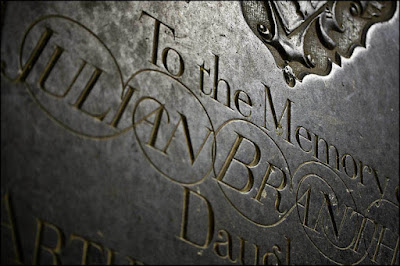
The stone slabs in the church floor over the graves of those who are buried inside the church caught my eye.  I was delighted by the quality of the lettering, which still looked crisp and fresh despite having been walked on for nearly 400 years in some cases.  It took a great deal of scrabbling about on the floor to get a suitable angle for these shots but I am fairly satisfied with the results.


The much reduced population of the parish of Hethel live in scattered houses down leafy lanes, and as visitors approach Hethel church - never easy to find for the first time – it is difficult for them to believe that they are a mere seven miles from busy Norwich.
   Hethel people have always earned their living principally from arable farming. Generations of farmers who have struggled with its heavy clays – the Brewertons, Cranes, Claxtons, Myhills and Rackhams – are remembered in the names of houses, lanes and in the churchyard itself.  One Hethel farmer, James Rush of Potash Farm, achieved national fame.  One dark November night in 1848, he, made his way to Stanfield Hall and there shot dead his landlord, Isaac Jermy and his son.  The crime, trial and execution caused great local excitement during the winter of 1848-9.


In a meadow to the northwest of the church is the Hethel thorn.  The hawthorn (crataegus monoguna), now in rather a sad state, was described in 1864 as “having a girth of 14’ 3” at five feet from the ground, whilst the circumference of the space over which its branches spread is 31 yards”.  Its trunk is now reduced to a mere shell and the branches are strangely entwined.  Its bark is hard and heavy and nearly all the interior wood is gone.  It is covered with lichen and crowned with mistletoe, but still blossoms profusely each spring. Tradition says that this tree is mentioned in an old chronicle as the meeting place in an insurrection during the reign of King John. The thorn is first mentioned in a deed from the early part of the thirteenth century as a boundary tree. It is certainly well over 700 years old and is now in the care of the Norfolk Wildlife Trust.


During the Second World War, Hethel airfield was an air base for the 389th group of the 2nd American Air Division.  B24 Liberator bombers flew from Hethel in raids over Germany.  This memorial to those who lost their lives stands just outside the church door.

Tuesday, 8 September 2009

Waterline


Remarkable things happen in the transition zone between air and water, especially along the waterline of boats where wonderful textures and colours are created by the corrosive effects of sun, wind and salt water.


The charming seaside town of Southwold on the coast of Suffolk, England, has been a source of photographic subjects for me for several years.  I am particularly attracted to the area around the small working harbour in the mouth of the river Blythe.  Here longshore fishermen still take fish from the North Sea as they come in season, and sell them fresh from several fish ‘sheds’.


The harbour is also a popular centre for leisure craft, including a flourishing yacht repair and maintenance business.  While the harbour offers lovely vistas of boats on the water and a charming view across the river to the village of Walberswick, my photographic eye has been drawn to the ‘found abstracts’ available on the battered boats that have been taken from the water for repair and refit.  There I’ve found a wealth of opportunity for creative photography.


It is an easy trip to drive from my home along the 40 miles of country back roads to Southwold and then back again.  Each time I explored Southwold I became more aware of the delightful colours and textures to be found along the waterline of these boats.  I quickly found beauty in the result of weathering and decay caused by neglect and the exposure to the elements.  This is an unusual subject, in that it is constantly changing.  Each time I returned to the harbour I would find that repaired boats had been returned to the sea and tired-looking boats had taken their place. While waiting their turn to be patched painted and restored I was provided with a fresh opportunity to make new images.


Since most of my work is close-ups of derelict buildings, rusted metal, graffiti and peeling paint, it seems only natural that I would be drawn to these timeworn boats as well.  These subjects allow me to apply my love of photography to my love of abstract and minimalist subject matter.


During the past five years I’ve returned to Southwold many times, and gradually built up a collection of abstracts.  In this Waterline series I’m pleased to commemorate boats of all kinds, and their constant battle with the corrosive effects of the sea.


Tuesday, 1 September 2009

Wabi-Sabi


Wabi-Sabi is a beauty of things imperfect, impermanent and incomplete.
It is a beauty of things modest and humble.
It is a beauty of things unconventional.


From the introduction to
Wabi-Sabi for Artists, Designers, Poets and Philosophers’ by Leonard Koren


I don’t think for one moment that I fully understand the Japanese Wabi-Sabi ethic but I do know that the kinds of images that I like have a great deal in common with it. Much of my photography features derelict buildings, rusted metal, graffiti and peeling paint. I find beauty in the result of weathering and decay caused by neglect and exposure to the elements.


Most of all though, I love images of articles and artifacts that exhibit wear or damage that has been caused by frequent human use and I like to contemplate the many and varied characters whose hands have touched these items over the years.


These three images portray humble and well-used objects that demonstrate my personal interpretation of Wabi-Sabi.


I found this little stool in the church of Waterden all Saints; it is a tiny church in a remote rural setting that is approached by a short walk across a field. The village of Waterden has completely disappeared now and in 1854 only consisted of 4 houses, 39 souls and 763 acres, all that remains is a rectory built in the middle of the 19th century and a farm some way up the road. A church was described in Waterden as early as the Domesday Survey of 1087. Waterden church seems hallowed by centuries of devotional worship and has a profound influence on all who know it.


This weary looking chair was discovered nearing the end of its life in the church of St. Mary Magdalene at Warham in N.Norfolk not far from Waterden. This church was nearly lost as it was declared redundant in the 1960s and looked likely to be demolished as this small village has two churches only about a mile apart. Fortunately the redoubtable Lady Wilhelmine Harrod, ex boyfriend of John Betjeman, set up the Norfolk Churches Trust which has saved many churches that were in near ruinous condition, one of which was this church at Warham together with its venerable old chair.


This old catch is on a stable door on a farm where we used to live and I have often wondered how many hands over how many years it has taken to wear this groove in the wood.


Related Posts Plugin for WordPress, Blogger...